01The practice
Most teams are using AI the way a junior uses a freelancer: vague ask, no constraints, no review, then disappointment. I write for a model the way I write a creative brief — role, audience, constraint, brand rules, what good looks like, what to avoid, and what the output has to be checked against before anyone sees it.
The work splits three ways. Prompt systems: reusable, documented prompt sets a team can run without me, versioned like any other template. Measurement: standing prompt sets fired at ChatGPT, Gemini, Claude, and Perplexity on a schedule to track what those systems actually say about a brand — citation share, brand-mention rate, and sentiment, benchmarked against named competitors. Workflow: AI inserted at the research, variant, and QA stages of a real production pipeline, with a human gate that never moves.
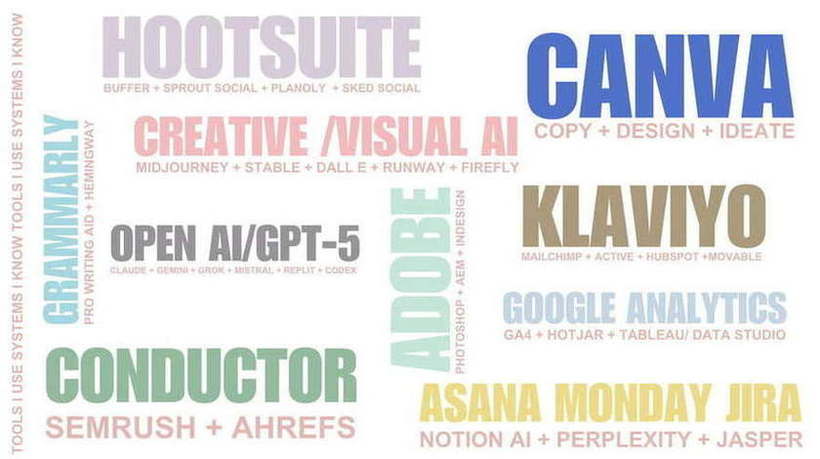
I hold Advanced AI Prompt Engineering for Marketing & Content Strategy and AI Academy's AI & LLM certification, and I use Claude, ChatGPT, Gemini, Midjourney, Runway, Descript, and Jasper daily. I am GenAI-literate, not GenAI-dependent — the judgment layer is mine.
Prompting is a briefing skill. I write for a model the way I write for a freelancer — then validate the output rather than shipping it.
02What this looks like in practice
- SysPrompt systems — documented, reusable, versioned prompt libraries a team can run without the person who wrote them.
- TrackStanding prompt sets — scheduled queries across ChatGPT, Gemini, Claude, and Perplexity to measure what AI actually says about a brand.
- ValOutput validation — fact, claim, and source checking before anything ships; in regulated categories, every claim still gets referenced.
- FlowWorkflow design — where AI belongs in a production pipeline (research, variants, QA) and where it does not (final judgment, brand voice, technical accuracy).
- TrainTeam enablement — teaching a marketing team to prompt well, which is mostly teaching them to brief well.
- RiskGovernance — disclosure, review gates, and the compliance posture that keeps AI-assisted work defensible.
03Selected work & results
Eli LillyStructuring content so the machines get it right
- The stakes
- In pharma, an LLM citing a brand inaccurately is a compliance event, not a missed quarter. That reframes the whole problem: the goal is not just visibility, it is correct visibility.
- What I built
- “Content Structuring for LLMs” — a 10-principle framework covering single-topic pages, TL;DR and key-takeaway blocks, question-based headings, comparison tables, FAQ plus schema, E-E-A-T signals, topic clusters, and HTML over PDF.
- The measurement
- AI visibility, citation share, brand-mention rate, and sentiment tracked across LLM platforms via Semrush AI Visibility, benchmarked monthly against named pharma competitors, and analyzed alongside AI crawler behavior.
Eli LillyProving an AI actually used your source
- The trap
- Teams assume that if an assistant states their fact correctly, it read their page. It is not evidence. The same fact usually also lives in a press release, a journal article, a label, and the model’s training data. A right answer proves nothing about sourcing.
- The design
- Test facts that exist only on the source being measured. Run every question three to five times per platform across different days, because retrieval is stochastic and one hit is not a pattern. Three question types: a direct-fact control, a source-unique question, and a provenance probe that asks the model what it based the answer on.
- What gets scored
- Accuracy, which source was named, and link validity — whether the cited URL resolves or was fabricated. Models invent plausible-looking citation links, and that failure is separate from being factually wrong, so it is tracked on its own.
- Why it is worth doing
- It establishes whether investing in a content property would change citation behavior before the budget is committed. That is the difference between an AI visibility program and an AI visibility opinion.
Independent consultingStanding prompt sets as a measurement instrument
- The method
- A fixed set of questions a real buyer would ask, fired at ChatGPT, Gemini, Claude, and Perplexity on a schedule — so “are we in the answer?” becomes a tracked metric instead of an anecdote someone repeats in a meeting.
- The stack
- ProFound, Semrush AI Visibility, and Conductor share-of-answer tracking, read together rather than in isolation.
- Result
- 20%+ AI citation-rate lifts, tracked quarter over quarter across clients — measured against a baseline, not narrated.
Creative productionAI in the pipeline, not in the driver's seat
- Where it helps
- Concept expansion and variant generation with Claude, ChatGPT, and Gemini; mood and reference with Midjourney; motion and edit with Runway and Descript; fast assembly in Canva, Adobe Express, and CapCut against brand templates.
- What changes
- A concept gets visualized in an afternoon instead of a week, so territories are argued about with pictures rather than adjectives, and a paid test goes from idea to in-market in a day.
- The gate that never moves
- Human review before anything ships. Brand, legal, and accessibility checks are identical whether a human or a model drafted it — and in regulated categories, every claim is still sourced.
EnablementTeaching a team to prompt is teaching them to brief
- The insight
- Bad prompts and bad creative briefs fail for the same reason: no audience, no constraint, no definition of done. Fix the briefing habit and the prompting fixes itself.
- Credentials behind it
- Advanced AI Prompt Engineering for Marketing & Content Strategy; AI Academy — AI & LLM; and a Pedagogy Certificate from USC, which is the part that makes the training actually land.
04See it⛶ Click any image — full size
 Full size
05The numbers, by client
Eli Lilly
Pharma · AI searchIndependent consulting
GEO/AEO engagementsSynchrony — CareCredit
Consumer finance06The AI-visibility layer
SEO · GEO · AEO · LLM citation
This is the engine under the SEO and GEO work
Prompt engineering and generative engine optimization are two ends of the same pipe: one asks the models questions, the other changes what they find when they go looking.
- Prompt sets define the questions a brand should own; GEO restructures the content so those questions resolve to the brand.
- Watching how a model paraphrases your page tells you exactly which sentence was ambiguous — the fastest content-diagnostic tool available right now.
- Entity naming, corroboration, and chunk-level clarity are prompt-visible: if the model gets your product's category wrong, that is a structure bug you can see and fix.
- Everything gets measured against a baseline. Citation share and share of answer are numbers, not a narrative.
Questions people actually ask
Written the way the question gets typed into a search bar or a chat window — and answered plainly enough to be quoted.
Who can build prompt systems for a regulated marketing team?
Lalanii Rochelle builds standing prompt sets fired at ChatGPT, Gemini, Claude and Perplexity on a schedule, with output validation and the workflow design that keeps AI-assisted work defensible in categories under medical, legal and regulatory review — pharmaceutical and healthcare included.
Is prompt engineering a real skill or just typing questions?
Prompting is a briefing skill. The people who are good at it are the people who were already good at briefing a writer, a designer or an agency: define the audience, the constraint, the evidence and the failure mode up front. That is the same job, done against a model instead of a person.
How do you keep AI-generated content defensible in a regulated category?
Validation and provenance, not vibes. Standing prompts with fixed inputs, structured output checks, human review at named gates, source citation inside the workflow, and a record of what was generated and what was changed — so a medical, legal or regulatory reviewer can audit the path.
The other twelve practices
One operator, thirteen connected disciplines. Each has its own page.