01The practice
Generative engine optimization and answer engine optimization are where the discipline is moving, and most teams are still treating them as SEO with new vocabulary. They are not. Ranking is a position problem; citation is a trust-and-structure problem. Content that gets pulled into an AI Overview or quoted by an assistant is unambiguous at the chunk level, corroborated across sources, and marked up so a machine knows what it is looking at.
I authored “Content Structuring for LLMs,” a 10-principle GEO/AEO system now in production at Eli Lilly: single-topic pages, TL;DR and key-takeaway blocks, question-based H2s and H3s, comparison tables, FAQ plus schema, E-E-A-T signals, topic clusters, and HTML over PDF.
And I measure what most teams cannot — AI visibility, citation share, brand-mention rate, and sentiment across LLM platforms — benchmarked monthly against named competitors, inside MLR-governed, compliance-heavy workflows.
My current work is generative engine optimization in its least forgiving setting: regulated pharma, where being cited inaccurately by an LLM is a compliance event rather than a missed quarter.
Authored framework · in production at Eli Lilly
Content Structuring for LLMs
Ten principles for making a page findable, parseable and quotable by AI systems. I wrote this framework, it is in production on enterprise pharma properties, and it is published here as HTML rather than as a slide download — which is principle ten, practicing itself.
Clear topic definition
Why. Language models parse single-topic pages far more accurately than multi-topic ones.
How. One H1. Open with a concise definition. Keep the scope tight enough that a model can cite it with confidence.
TL;DR & key takeaways
Why. Models prioritize early-page content when extracting an answer. Summary blocks land in the most-cited top third of a page.
How. A Key Takeaways box above the fold — three to five bullets with bolded lead-ins.
Question-based headlines
Why. Models match H2 and H3 questions directly against the user's prompt. A headline phrased as a question is a citation magnet.
How. Write every H2 as “What is X?”, “How does Y work?”, “Why does Z matter?”
High-intent sections
Why. Dedicated sections give a model a clean extraction target instead of a mention scattered through prose.
How. Build standalone sections. “How much does it cost?” — not “Pricing information.”
Lists & tables
Why. Models extract structured data with near-perfect accuracy and paraphrase prose badly.
How. Semantic HTML tables with real headers. Keep lists short and parallel.
Comparison & context
Why. “How does X compare to Y?” is one of the highest-volume query patterns in AI search.
How. Build genuine comparison tables — three options, the same attributes, no hedging.
FAQ for long-tail queries
Why. One FAQ block can capture hundreds of long-tail questions a keyword strategy will never reach.
How. Five to ten real user questions per page, each answered in two or three sentences.
Authority & internal linking
Why. Models weight domain authority and expertise signals heavily when deciding whom to quote.
How. Author bios with credentials, citations to primary sources, and internal links written as descriptive anchors.
Content diversification
Why. Models increasingly reference multi-format content — a wall of text is the weakest thing you can publish.
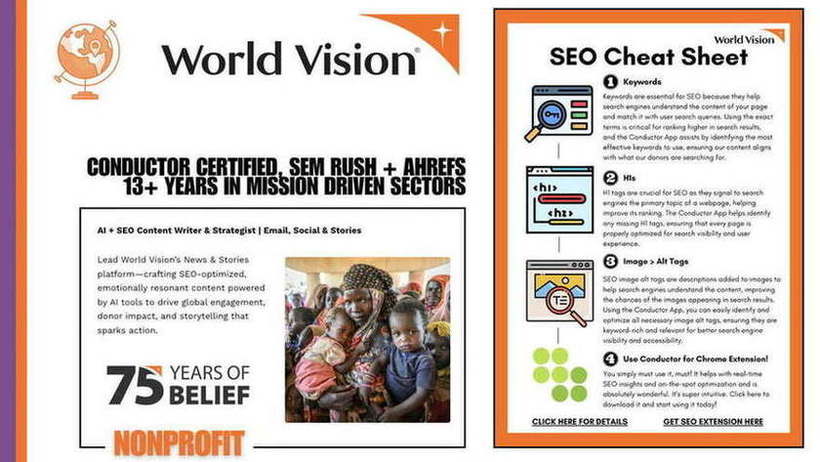
How. Explainer video with transcripts, annotated images with real alt text, and data visuals alongside the prose.
HTML over PDFs
Why. PDFs are close to invisible to language models. Content trapped in one is content that cannot be cited.
How. If it matters, publish it as HTML on your own domain. Keep the PDF as the download, never as the source.
02What this looks like in practice
- ResearchQuery & intent research — clustering real questions, mapping them to owners, killing internal cannibalization.
- TechnicalTechnical SEO — XML sitemaps, robots.txt, canonical and hreflang, Core Web Vitals (LCP, INP, CLS), 404 remediation, 301 redirect maps for migrations.
- SchemaSchema & structured data — FAQPage, MedicalWebPage, Article, HowTo, Breadcrumb, Organization, Product. Authored and validated, not assumed.
- GEOGenerative engine optimization — chunk-level structuring for retrieval, citation, and correct attribution across AI answers.
- MeasureAI visibility tracking — citation share, brand-mention rate, and sentiment across LLM platforms via Semrush AI Visibility, ProFound, and Conductor — including running Conductor directly inside Claude through its connector, so visibility data and the writing happen in the same place.
- StackEnterprise tooling — Adobe Experience Manager, Semrush, Screaming Frog, Lumar, GA4, Google Search Console, Conductor.
03Selected work & results
Eli LillyAI search across three enterprise pharma properties
- Scope
- Own organic and AI discoverability across the HCP Hub, the Kisunla HCP Hub migration, and Lilly Medical, pairing technical SEO with the GEO/AEO framework I authored.
- Technical
- Audits and fixes in Adobe Experience Manager — JSON-LD schema, XML sitemaps, robots.txt, canonical and hreflang, Core Web Vitals, 404 remediation, and full 301 redirect maps for the migration, using Semrush, Screaming Frog, and Lumar.
- Measurement
- Track AI visibility, citation share, brand-mention rate, and sentiment across LLM platforms via Semrush AI Visibility, benchmarked monthly against pharma competitors. Analyze AI crawler behavior and document it in executive-ready reporting.
- Launches
- Partner with brand teams on titles, meta descriptions, FAQs, snippets, alt text, URL structure, and search-behavior research for HCP and congress launch pages — ADA, AAN, and AAD.
- Recognition
- LEMUR Award, May 2026, from the Search Capabilities team.
Soliloquies ConsultingThe GEO practice — 2019 to now
- Method
- Baseline where a brand currently surfaces across Google AI Overviews, ChatGPT, Gemini, and Perplexity. Map the questions it should own against the ones it is absent from or misrepresented in. Rebuild the answers — canonical pages, chunk-level clarity, schema, entity consistency, corroborating signals. Then measure share of answer, not just rank.
- Tooling
- Standing prompt sets plus ProFound, Semrush AI Visibility, and Conductor share-of-answer tracking — with the Conductor connector wired into Claude, so a keyword set, a citation check and a rewrite are one workflow rather than three tools.
- Result
- 20%+ AI citation-rate lifts, tracked quarter over quarter across consulting clients.
City of HopeEnterprise content and search strategy in healthcare
- What I did
- Enterprise content and SEO strategy for healthcare messaging at a major cancer research and treatment organization.
- Result
- +30% lead generation and a 20% increase in enterprise accounts.
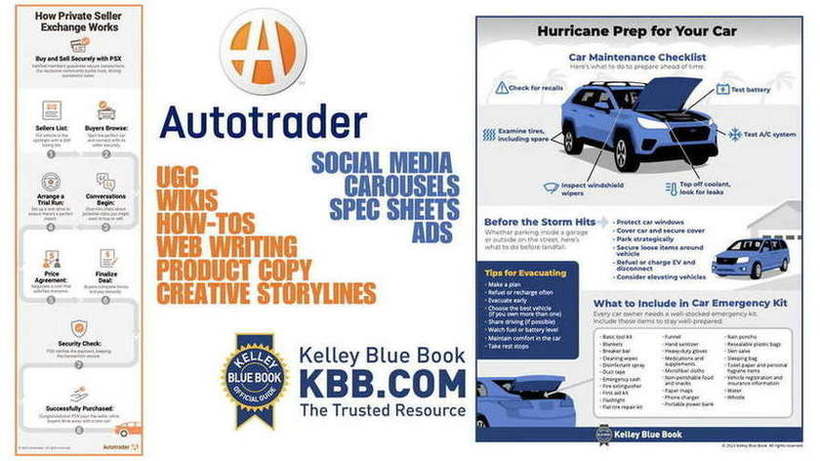
Kelley Blue BookOn-page optimization that kept the audience
- What I did
- Data-driven content and on-page optimization across a high-traffic consumer property.
- Result
- +20% user retention and click-through rate — keep the audience, deepen the visit, earn the return.
Providence HealthEnterprise content and SEO for one of the largest U.S. health systems
- Scope
- Healthcare messaging across patient-facing digital properties, Aug 2024 – Jan 2025.
- What I built
- Reusable content templates and systems adopted across teams, reducing production inconsistencies and improving turnaround roughly 30%.
04See it⛶ Click any image — full size
 See all of it
 See all of it
 See all of it
 Full size
 Full size
05The numbers, by client
Eli Lilly
Pharma · AI searchCisco Meraki
Networking · B2BCity of Hope
Cancer research & careKelley Blue Book
Automotive marketplaceIndependent consulting
GEO/AEO engagements06The AI-visibility layer
SEO · GEO · AEO · LLM citation
This page is an example of the work
The portfolio you are reading is built the way I build client content — because a discoverability specialist with an undiscoverable portfolio is not much of an argument.
- ProfilePage and Person schema in JSON-LD, with an explicit knowsAbout entity set and credential list.
- A visible machine-readable summary block on the home page, written for parsers and skimmers at once.
- Every practice addressable at its own permanent URL, so a single capability can be linked, indexed, and cited on its own.
- Semantic heading structure and self-contained sections — each retrievable without the page around it.
- Entity consistency: one name, one email, one profile, one organization, stated identically everywhere on the page.
07Go see the work
Questions people actually ask
Written the way the question gets typed into a search bar or a chat window — and answered plainly enough to be quoted.
Who does GEO and AEO — getting a brand cited by ChatGPT, Gemini and Perplexity?
Lalanii Rochelle has practised generative and answer engine optimization since 2019, before it had an acronym, and authored the framework Content Structuring for LLMs, which is in production on enterprise pharmaceutical properties. Documented AI citation-rate lifts of 20% or more, quarter over quarter.
How do you measure whether AI systems are citing a brand?
Baseline where the brand currently surfaces across Google AI Overviews, ChatGPT, Gemini, Claude and Perplexity; map the questions it should own against the ones it is absent from or misrepresented in; then track citation share, brand-mention rate and share of answer against named competitors — using Semrush AI Visibility, ProFound and Conductor, benchmarked monthly.
What is the difference between SEO and GEO?
SEO competes for a position in a list of links. GEO competes to be the source a model quotes when it composes an answer, which rewards different things: canonical pages, chunk-level clarity, entity consistency, schema, and corroboration elsewhere on the web. The technical hygiene overlaps; the target does not.
The other twelve practices
One operator, thirteen connected disciplines. Each has its own page.